

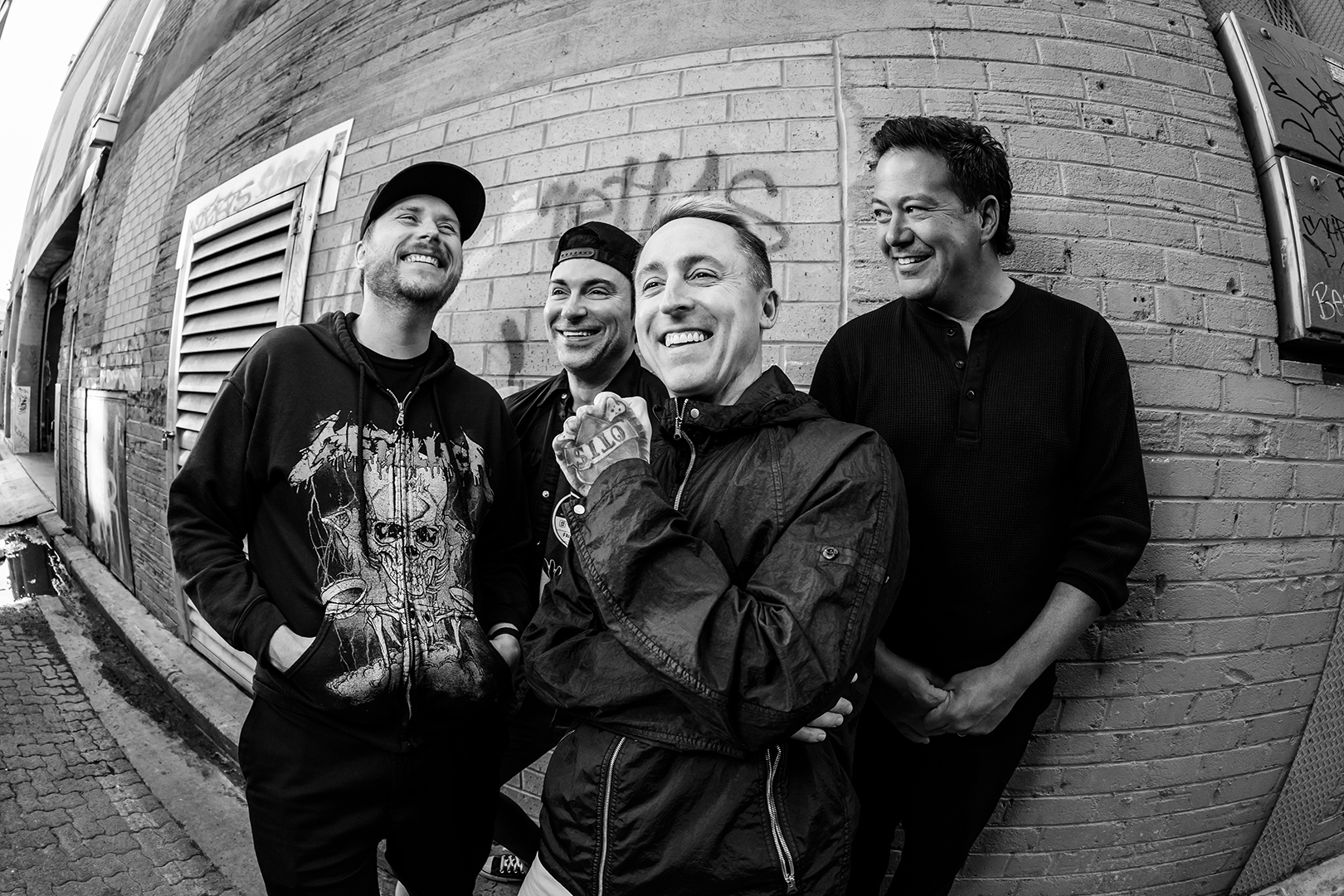


Yellowcard: “Anytime you share something that’s meaningful in a way, it can reach other people; Emo, pop punk music, for me it’s a generational thing because it’s all I wanted to do in life.”
From whatever happened during the recording of Lights and Sounds (2006), them responding to how “Only One” and “Ocean Avenue” being regulars at karaokes, to Travis Barker being featured in their upcoming album, there are plenty to see (and remember) from our chat with their violinist of Yellowcard, Sean Mackin.

Words by Whiteboard Journal
Words: Garrin Faturrahman
Photo: Yellowcard
It is scientifically proven that we reach for the comfort of nostalgia in uncertain times. Would that pose as an explanation as to the resurgence of emo music again?
Though we both know that it never went away (and that it is *never* a phase), but we’re seeing a positive trend in the approval (or acceptance?) towards such confessional, vulnerable songs in the masses. To commemorate this wave of nostalgia towards one of the things that defined the mid-2000s, we conversed with one of the bigger names of that era: Yellowcard.
From whatever happened during the recording of Lights and Sounds (2006), them responding to how “Only One” and “Ocean Avenue” being regulars at karaokes, to Travis Barker being featured in their upcoming album, there are plenty to see (and remember) from our chat with their violinist, Sean Mackin.
In a time where nothing certain awaits at the doorstep, may Yellowcard’s songs (as well as their upcoming album) be a place of temporary comfort, especially for those who needs it the most.
Your songs are still finding life here through karaokes and singalong sessions. If you had something to say to these people (me included), what would that be?
First, I would say thank you so much for singing along with your favorite Yellowcard songs. And make sure you breathe deep, so when you scream your lungs out, it’s loud as it can be.
“Breathing” is the second song from Ocean Avenue, was it?
“Breathing” or “Ocean Avenue,” but “Only One,” I know that it’s a wedding karaoke song. “Ocean Avenue” is always top of the charts, but I always get videos from “Only One,” of people at weddings or karaoke. They send it to me at 1 in the morning, I’m asleep, and they’re yelling, “scream my lungs out!” I know it’s a fan favorite.
“Ocean Avenue” is also still the crowd pleaser, if that’s the correct term.
A hundred percent, that’s the number 1 Yellowcard song. If we’re talking karaoke, Only One’s right there.
It’s really cathartic, “Only One.” I love it.
Thank you 🙂
On that note, we saw how Yellowcard was catapulted onto bigger success through other mediums like, in your case, video games such as Flatout and Madden. In today’s age where social media and 5-seconds-of-fame reigned supreme, would you say such a plan could still be pulled off?
For Yellowcard, we’ve had great success, really, from just the acceptance and sharing from our fans. Yellowcard, in this chapter of Better Days—music that we’re doing in 2025—we’re trying to really be honest and true to ourselves. I understand that the platforms of TikTok, Instagram, and Twitter, everything’s still there, but what’s important is our love and our affection and our appreciation for our fans.
Video games still hold such a special place, I think, in entertainment. And just a chance for some people to have some fun or find a little safe place and it’s just another form of entertainment. The cross-media is still apparent. We have some opportunities in this chapter of Yellowcard, but I think, still, the reality of what holds true and what is ‘King’ is the fans, our fan interactions, our fan appreciation, and this album for us is exactly that.
We didn’t want to put out 10 songs of Yellowcard music that’s just another “Hey guys, we can write songs!” We set out to write the best Yellowcard album. And it’s pretty tough cause I feel like we’ve done pretty good for ourselves. We never tried to be famous, we never tried to be popular, we wanted to write songs on tours and play shows to our friends, which is what we’re doing. But we said in ‘25, we had this momentum from 20 years of Ocean Avenue for Yellowcard: it’s got to be special. It’s got to be different, it’s got to be true, and honest. I think that’s what this Better Days cycle for Yellowcard is.
Better Days still does see the best of Yellowcard’s songwriting—from angsty guitar riffs, melodious vocals and harmonies, and of course the violin! What goes on behind-the-scenes that keeps this direction alive in your music?
Behind the scenes, I think we all understand how fragile Yellowcard can be. We all understand that while we’re being serious and trying to be—have the best performance. We also wanna capture what makes us unique and what makes us special. I look at the guys and the band, and Ryan has worked so hard to be the best singer that he can be.
Sometimes when you’re 20, you get lost in trying to hang out with your friends, and trying to have fun, or maybe there’s some distractions—where we’re at in our life right now, we can find a balance of doing those things but also knowing when it’s time to be ready to go to work.
Ryan, this is his best performance as a singer. He just nailed it down. We got Travis Barker on the drums, and not just Travis to be the best drummer in generational talent, but Travis Barker, also the producer, was so surprising—it shouldn’t be surprising, but it was because I didn’t know what to expect. You have this talent and he’s like, “Oh, I like this,” “Oh, let’s try a different way,” “Oh let’s try and beat that idea,” and he’s just so positive and so focused that it made you better at what you do, and that’s what we have always tried to do with Yellowcard.
So to have him as a tool and a soundboard, we can talk about notes, and music, and direction all day, but to have someone that’s “Oh, let’s try this,” and to follow that direction or ask him “Hey, Travis I have this great idea,” and he’s like, “Oh man, I love that. Let’s try that.” So we have a unified team and that’s what makes this Better Days still feel like vintage Yellowcard but it’s new, and it’s powerful.
What do you mean by this fragility in Yellowcard?
I think the end of the Yellowcard chapter for us was in 2017. I mean, we retired, we resigned from music. We wanted to say goodbye cause we thought we were walking away. I mean, it’s my first love. I’ve played violins since I was very young. I didn’t want to at first, my mom made me. Then I learned to get good at it and I learned to find my own thing and lifelong friends. We had to say goodbye because it was so hard to balance the business of Yellowcard with the art and the love and the fun stuff of Yellowcard. When you’re a teenager, you’re 20 and you’re chasing this thing and you don’t know where it’s gonna lead you and there’s this sense of adventure, but as life goes on you have responsibilities and family.
I was the first person in the band to have kids and to be able to try and maintain some type of life and support system outside of Yellowcard. It gets hard, I think. We all struggled with that differently. By walking away 8 years ago, which was sad, we all had to deal with that pain and emptiness differently.
Now that we’re back together, the respect that we have for Yellowcard, understanding how few people get to do that, the appreciation that we have for the people that listen to our band, the appreciation that we have for the things that happened to our band because we are together, the things that happened to our band because we’ve written music and songs and what that means to people—it’s not lost on us. We don’t have to do that, it’s not a burden—it is a reminder that we get to do it, and that’s the fragile moment in Yellowcard that we want to keep safe.
That is what we all understand. And we have, for a long time, just trying to find the right way to protect it and share it with people, and really just say thanks to everyone that has reminded us of that and reminded us of how much our songs and we mean to them.
We’re feeling that right now, whether it’s social media, or text messages, or- I met someone, and they were like “You know, you guys put out a new song, that’s really good,” and those moments, it’s been a long time since we had that, obviously, by stepping away from Yellowcard. But having it again is so special and gorgeous. Very grateful for that. That’s the fragile moment that people share with us now. It’s not lost, it’s very important and we all got really close.
That’s actually very profound, thank you. It’s almost like a calling.
Yeah. Sometimes if you’re lonely or if you’re down, or when you’re in a band and you’re traveling, you can still have a bad day. So it feels like you have to do something. If you fall in love with what you do for work, you never really work for it, cause you’re doing something that you love. It’s just nice to have the opportunity to do something that we love so much again.
I’ve enjoyed how Lights and Sounds is vividly narrative, like it has its own cohesive storyline from the first to its last track. What draws you into this style of writing, and will we see it again in Better Days?
As a musician, you have your entire life experience to write your first record. When you write your second record, “Hey, here’s 6 months, go do it again.” The depth that you try to find in that moment can be misunderstood, and for so many people, as listeners and consumers of music, it’s easy to say, “Oh, that was a one hit wonder,” or “That one was different,” and the reality is that it is different. So much happens to you as a musician when you start writing music and you make music because you love music. After you have some success or more people hearing from you, they wanna share their opinion of you and it makes you protective. It makes you put on armor, you kinda have to toughen up.
Ryan, he’s a perfect narrator, an amazing storyteller. He thinks of ways to share words within melodies in a way that I couldn’t do. I think that’s what makes us a good team. Hopefully, I’m able to share some musical insight and he’d go “Oh, I didn’t think of it that way,” but when I hear him tell stories and I’m like “That’s the best way you could tell that story, that’s the best way to say that.”
When I look at Lights and Sounds, I think Ryan wanted to share some of the challenges that he’s had through the course of the Yellowcard Ocean Avenue arc, whereas Ocean Avenue was more free—it was dropping out of college, it was chasing the dream.
Yellowcard’s Lights and Sounds was about “Hey, this is what we’re going through right now,” and there are these challenges now with this new version of Yellowcard, and there are expectations, instead of just joy of listening and sharing. Better Days takes a look at both of those versions of Yellowcard. I think you’ll hear that in the full body of work right now—obviously we only have the title track single “Better Days” out, and we have “honestly i,” which really showcases classic Yellowcard. In October, when you get the full Better Days record, I think you’ll see that arc which is really a great mix of all of the sounds and vibes of Yellowcard into an updated, really nice package. We did that for you and all those listeners. We just wanna make sure that people go out and hear these songs—it’s really special to us.
It’s special to us as well. So it’s an amalgamation of all the Lights and Sounds. Ryan is a storyteller, like in “How I Go.” That’s a great story to tell, I feel. Quick question: who sang the female vocals of “How I Go?”
That is just an epic story. There is a country group—they’re called The Chicks now, they’re formerly called the Dixie Chicks, and that’s Natalie Maines, and they were actually recording in the studio next to us and they had a door open and we would hear them.
Obviously a different style of music, but her talent—they are so powerful and have so much talent. Just from being in close quarters with them, “Hey, we have this ballad, would you like to listen to it? Maybe sing along to it?”
Then Natalie came in and sat with us and she was so gracious with her time and she sang whatever she wanted to sing and we weren’t gonna tell her any different.
It was a really special moment to be recognized from another artist on a much higher level and she felt that she made it so special. That’s a great moment for our bands.
No wonder. I’ve always felt the first chorus of “How I Go,” the vocals were very impromptu, very organic.
We were trying to capture a really special sound we wanted to showcase. It was important that it felt that people were like “You are Ocean Avenue now. You’re not Yellowcard anymore, you’re just Ocean Avenue!” So it was special for us to be able to show, “Hey, as Yellowcard, we have all these flavors. We’re not just this tiny speck of that one song”. It was a fun adventure, to find all of the colors of Yellowcard and it definitely shaped our sound for years to come.
We saw how emo is really not just a phase—even part of Stereogum’s 50 best songs are emo-tinged songs! Could we get a take from you as to why songs of this genre (emo, pop punk, etc.) are still finding their way into ears and hearts?
Anytime you share something that’s meaningful and from your heart and important, and you share it in a way with music, it can reach other people. Emo music, pop punk music, for me it’s a generational thing because it’s all I wanted to do in life. I wanted to hang out with my friends and I wanted to play music in a different way.
Sometimes I imagine I’m probably just a guitar player in a violinist’s body and I’m just shredding the solo, just the meanest Yellowcard solo. But for us, it was something about reaching out and following your dream, and I think that’s such a normal life quest in any era.
If you’re just “Hey, take the leap. You have your brothers with you, you have your family standing right next to you,” I think that’s why this music is so important, it’s because we embrace that theme and we put it to music of our timeline and the best music of our life. That’s definitely a storyline for Yellowcard as well. Me being home, following your dreams, trusting your friends, doing everything with your heart, I think those are timeless themes in and of itself. I’m sure you’re gonna find that in Yellowcard songs and some of our close peers and friends.
Hopefully, for years to come, people are listening, singing karaoke, singing at weddings, to all the Yellowcard songs. 


